


The Buddha attains nirvana
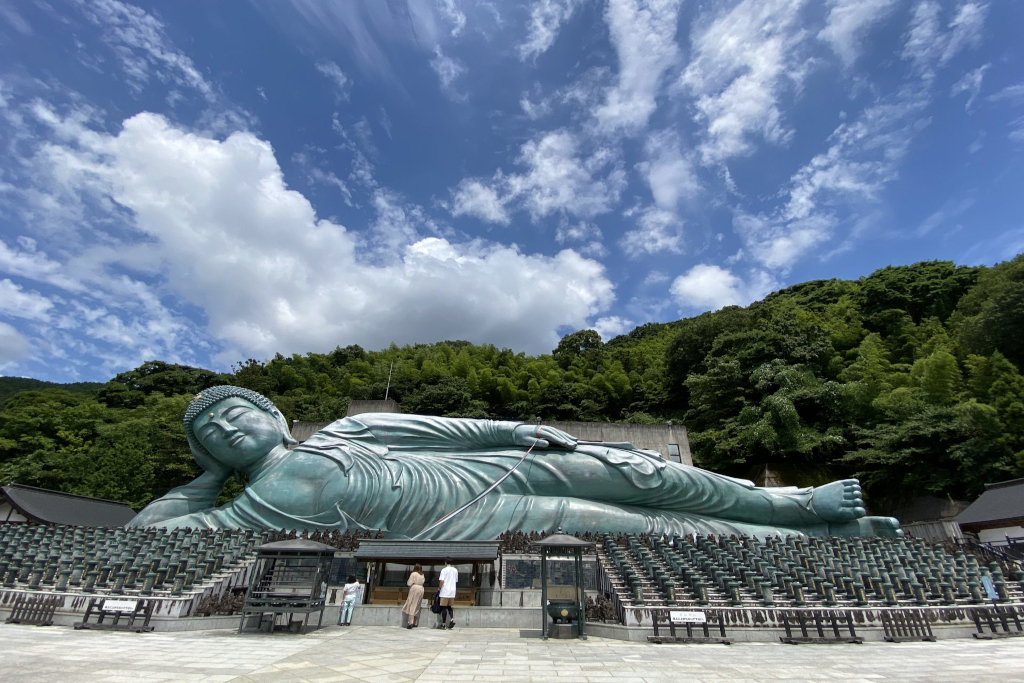
Nanzo-in (南蔵院) is a Buddhist temple in Fukuoka Prefecture and is famous for its bronze statue of the reclining Buddha, which is said to be the largest bronze statue in the world.

Nanzo-in (南蔵院) is a Buddhist temple in Fukuoka Prefecture and is famous for its bronze statue of the reclining Buddha, which is said to be the largest bronze statue in the world.
Nanzo-in Temple was originally located on Mount Koyasan, but local anti-Buddhist authorities threatened to destroy the temple in 1886. Moved to its current location in 1988 with great effort, Nanzo-in Temple belongs to the esoteric Shingon school of Buddhism. This sect focuses on nature and mountains, so most Shingon temples are hidden in forests or on mountain tops. Nanzo-in is no different. Located in the picturesque, wooded town of Sasaguri, the temple is a stop on the Sasaguri 88, one of Japan's most famous pilgrimage routes.
The surrounding area is fun to explore, dotted with ponds, temple houses, and sculptures of animals and deities. Nanzo-in itself is said to bring good luck after a high priest once won the lottery on the temple grounds. For this reason, travellers from all over Japan visit to pray for good luck in love, work, or school.

Regarding the Buddha
Hidden at the top of the mountain, the path from the nearest station to the Great Buddha is an opportunity to breathe fresh air. The reclining Buddha is 41 metres long, 11 metres high and is said to weigh around 300 tonnes. Giant Buddha statues are common in Japan and can be found in many cities across the country. The one in Fukuoka, called Nehanzo or Shakanehanzou, depicts the scene of Buddha dying and reaching nirvana. This statue was a gift from Myanmar in gratitude for the financial and humanitarian aid received. You can admire the Buddha from the front, but you can also walk around it without hindrance. Five different coloured cords are tied to his hand, and visitors can connect with him by holding these cords in their hands. This gesture represents holding Buddha's hand as he reaches nirvana and, at the same time, absorbing his knowledge. The statue lies on a green expanse of forest and faces a collection of 365 columns or vases.
The meaning of the columns
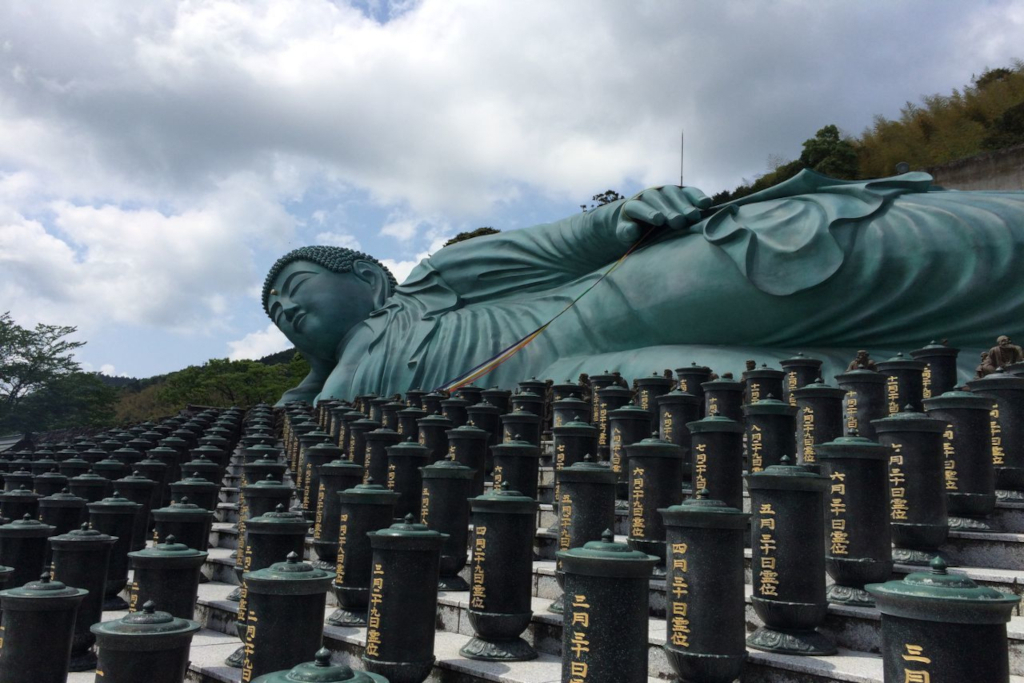
There are several explanations for the meaning of the columns near the statue. The first explanation concerns the correspondence with the days of the year, and people go to Buddha to send messages to their ancestors and deceased loved ones. The message is written on a piece of paper and placed inside the jar corresponding to the day of the loved one's death. Other theories claim that the ashes of the deceased are kept in the jars.
The Reclining Buddha
Buddha is usually depicted in a meditative pose, but this statue shows him lying down, signifying his passage into Nirvana, a very common depiction in Southeast Asian countries. It is no coincidence that the statue is linked to Myanmar, as Nanzo-in has donated money to the poor in Myanmar and Nepal for many years. As a token of gratitude, a Buddhist society in Nepal decided to donate some of Buddha's ashes.
The pilgrimage to Sasaguri
Shingon Buddhism is strongly linked to Shikoku-88, a 1,200 km pilgrimage around the island of Shikoku. On Shikoku-88, pilgrims take between 6 and 8 weeks to visit 88 temples during their walk. The temple complex on Mount Koya is a place where pilgrims often go before starting and after finishing their journey. Since Nanzo-in Temple was moved to Mount Koya, a Shikoku-88 equivalent was established in Kyushu in the form of the Sasaguri Pilgrimage Route. This shorter route can be completed in about 3 days, taking pilgrims to 88 locations, with Nanzo-in being the main location. Inside the large reclining Buddha, sand is stored from each of the 88 temples in Shikoku.
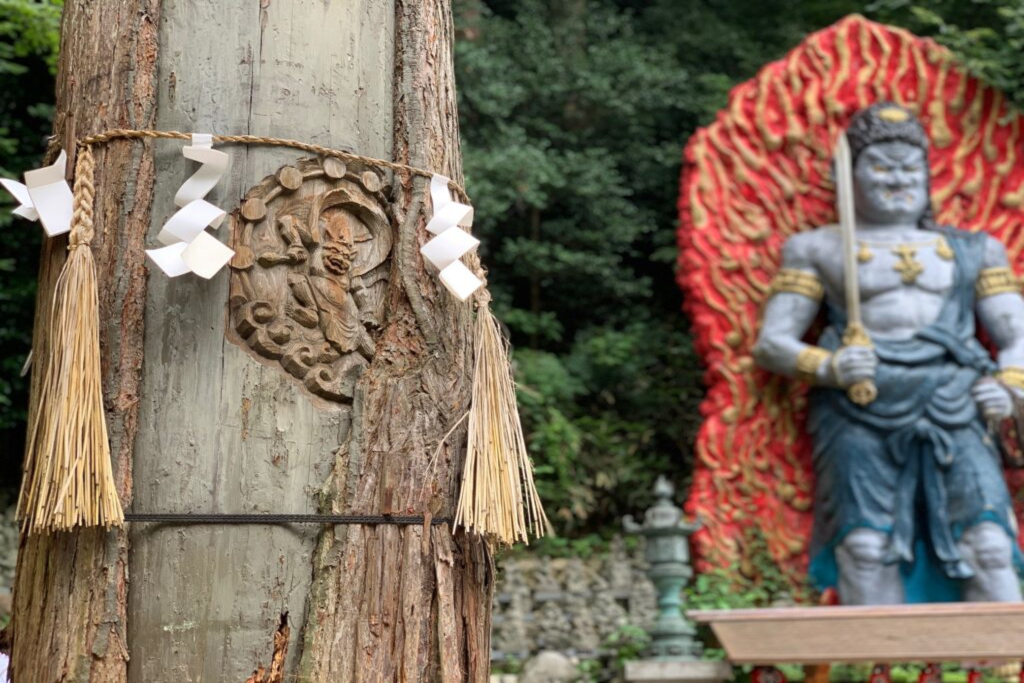
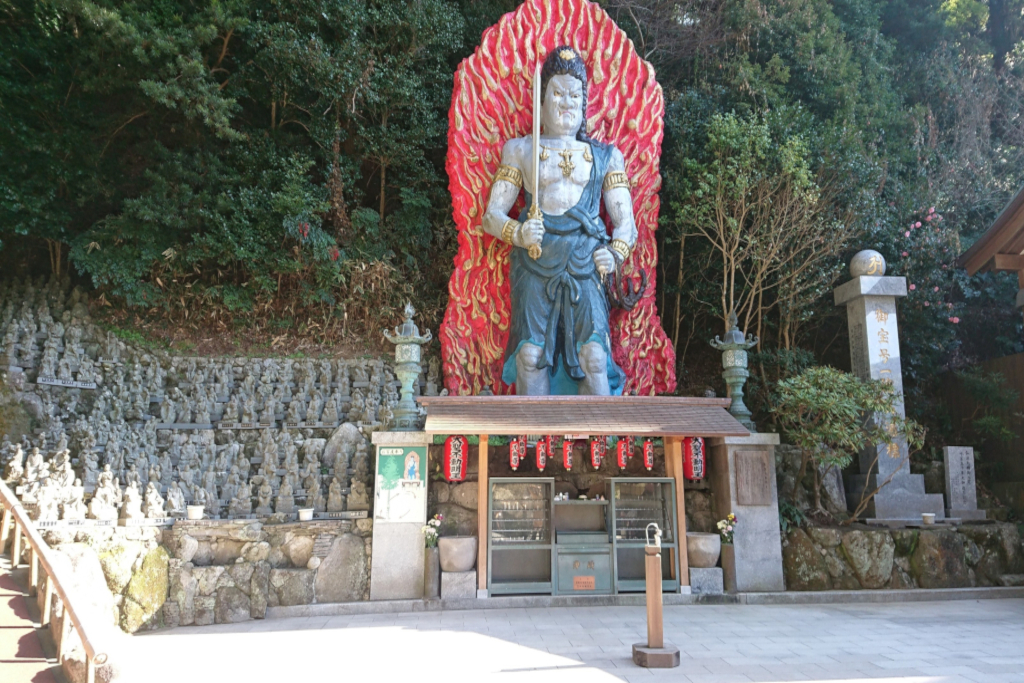
Acala
The statue of Acala is 10 metres tall and depicts an angry-looking boy with a sword in one hand, a rope in the other, and supported by a sea of flames.
This character is represented in all branches of Buddhism and dates back a long time. Initially called Acalanātha, meaning immovable protector, he is one of the five kings of wisdom in Vajrayana Buddhism. The five kings of wisdom are the protectors of the five Buddhas of wisdom. Therefore, Fudo is the king of a group of five protective figures and possesses the gift of protecting all living beings.
Acala, chosen by Chinese Buddhists, was imported into Japanese Buddhism by Kukai, who had studied in China and exported the character and name to Japan.
How to get there
To reach this destination, simply take the Sasaguri Line from Hakata Station towards Nogata. Once you arrive at Kidonanzoin-Mae Station, walk for 5 minutes to reach the shrine.